
History
OVER 80 YEARS OF SERVICE TO THE TOWN OF HOOKSETT
"Until the late 1800s, the medical field did not know how diseases were spread through populations. Many thought that evil gases came up from the soil or that illness was caused by the alignments of the stars and moon. As disease origin and transmission became better understood, the importance of separating sewer disposal from water supply was recognized as critically important."
According to the History of Hooksett, the first public water systems in town were privately owned and located in the Village area. They included the Hooksett Aqueduct Company and the “Arel System.”
 (opens in a new tab)
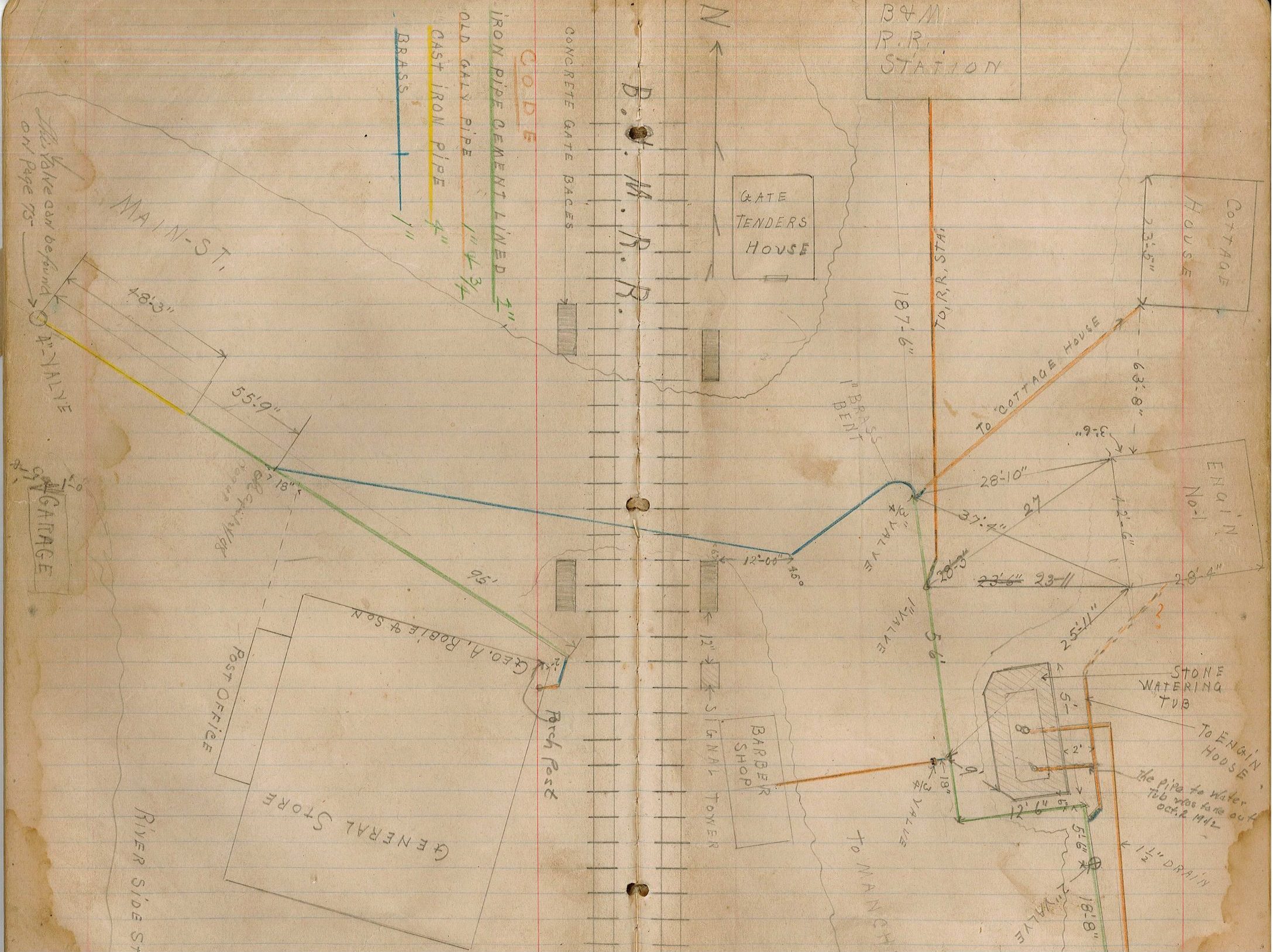
This sketch displays pipe configurations recorded by Hooksett Aqueduct Company in the 1930s–40s. "Engin No. 1" is now the Precinct office on Riverside Street.
The Hooksett Aqueduct Company, later Hooksett Aqueduct Co., Inc., was incorporated in 1899 and served the Village on the west side of the Merrimack River. It included the Pinnacle Pond intake, a pump house, a “reservoir” (some sort of elevated storage) and a number of relatively small supply mains, house services and other equipment.
Deeds as early as 1902 reference buried pipe and a water supply system in the vicinity of Pinnacle Pond. A 1931 plan of this system indicates that it was owned by W.M. Davis at that time and that a series of new 2” and 4” water mains were proposed to extend from the Pond down Pine Street and Main Street to Robie’s Store and from Main Street up Rosedale and Maple Streets to High Street, which is now referred to as West River Road (RT3A).
While much of the knowledge about the Hooksett Aqueduct Company is lost to history, the Precinct is in possession of an old book of tie measurements to homes and valves in the Village (excerpt to left) that sheds some light on the scale of the system's operations back in the early 20th century.
The Arel System was owned by Willie Arel and served the east side of the river near the former Hooksett Manufacturing Co. and Hooksett Mills Co. The start date of the system is unclear and no records of incorporation appear to be on file; however there are references to water rights which appear to be associated with the system in records documenting Mr. Arel’s land purchases from 1903 to 1917. Charles R. Hardy's 1969 "Hooksett Historical Sketches" states that Arel first installed a well on Merrimack Street in 1916 to serve some of the tenements he owned in that area. Those records and former Precinct employees suggest that one or more wells or springs in the area near Merrimack Street and Dundee Avenue may have provided the water supply for the Arel System; plans on file with the County Registry suggest that the system was installed in 1921 and included seven wells, two reservoirs/tanks and a network of 2" and 4" mains. The Precinct's 1955 Annual Report indicates that the hydrants on the system date back to the 1890s. Precinct records further suggest that the Arel System was also known as the Dundee Mill System.
According to the NH DES, “… in the early 1900s, a number of major public water systems in NH were privately owned and operated for a profit… by the 1920s this private sector investment had significantly departed for greener rather than blue pastures. As a result, city and town governments were forced to take over these utilities.” In our Village, the History of Hooksett suggests that both of the privately owned existing water systems “were inadequate to meet the growing needs of the residents” due to population growth. Efforts to conduct studies and raise money to establish a suitable new public water system were made at Town Meetings in 1907 and 1923, but they were not successful.
To help address this issue, the Hooksett Village Water Precinct was formed at a public meeting at the Hooksett Town Hall on November 10, 1941. At this meeting, the first Water Commissioners (Alfred Lambert, John B. Mulaire and John S. Kimball) and officers (George A. Cook, Moderator; Rachel LaFleur, Clerk; Herbert J. Lasalle, Treasurer) were elected. The first official Precinct meeting was held on April 7, 1942. The remainder of that decade was spent conducting preliminary studies to identify the most suitable sources of supply, negotiating with existing water systems, establishing the first Precinct “general fund” (via a tax in 1948 at $0.05/$100 valuation), and adjusting Precinct boundaries.
The 1950s were a decade of construction and expansion for the Precinct. The Precinct began pumping in 1950 after the Public Service Commission of NH authorized the transfer and sale of the Hooksett Aqueduct Co. to the Precinct, which the Precinct reportedly acquired for $9,750. At the same time, the Precinct borrowed $115,000 from Suncook Bank via a 28-year bond to replace, upgrade and expand the existing water systems. A new pump house and pond intake were built soon thereafter, and several miles of 2”, 6” and 8” water main were also installed including 20 hydrants, 36 gate valves and “13,000 pounds” of cast iron fittings. A 200,000 gallon welded steel standpipe (storage tank) was constructed in the Thompson’s Corner area off of Hooksett Road. The Precinct acquired the Arel System in 1953, and by 1958 had adopted a detailed written Schedule for Water Service (regulations). This 1950 map displays the acquisitions and upgrades planned for the Precinct at the time.
In the 1960s, construction continued as the pump station (see photo to the right) was rebuilt and Brickyard Brook was partially diverted from what is now the Pike Quarry area to supplement Pinnacle Pond via roughly a mile of buried 16” water main. The Precinct boundaries continued to expand and by 1965, the Precinct had grown from roughly 100 customers to over 335 customers. In 1966, the Precinct’s engineering consultant predicted the addition of 150 new services by 1968, mostly in new residential developments planned for the Pine Street, Pinnacle Street and lower Main Street areas. According to Precinct meeting records at the time, “the growth of the Town has just about reached the capacity of our present water supply.” Test drilling for possible new water supplies, including locations off of Hackett Hill Road, was completed and the potential for acquiring water supply land in the Head’s Pond area was investigated.
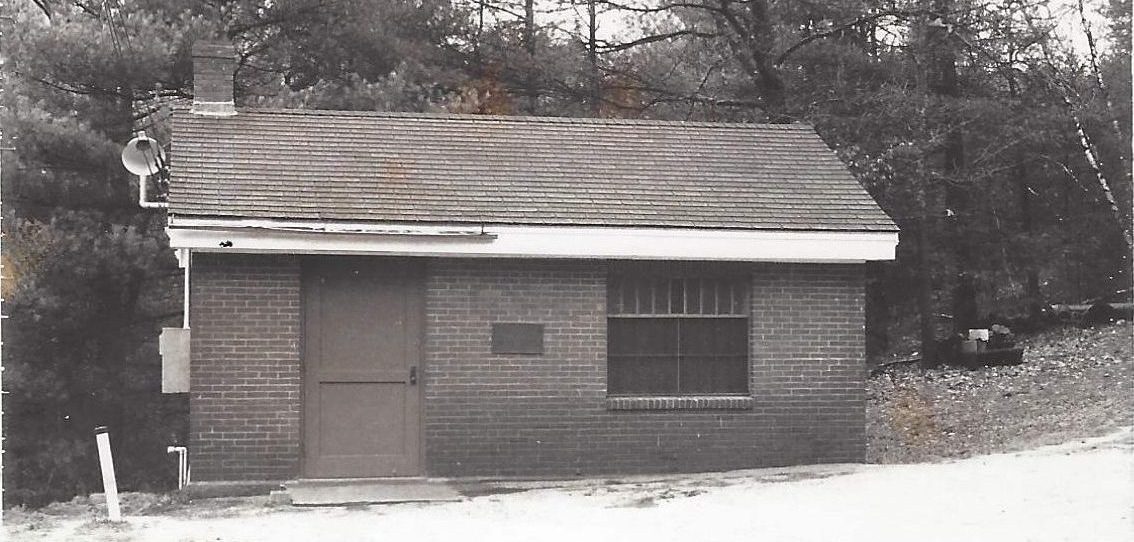
The "Old North" building off Pine Street served as the Precinct's sole pump station, distributing chlorinated water from Pinnacle Pond before wells were drilled.
Alfred Collerette was listed as the Precinct's Superintendent as early as 1956. In 1967, the Water Commissioners voted to have Leo Hebert start working with Superintendent Collerette “to learn the working[s] of the Precinct.” By 1968, it “was agreed to pay Mr. Hebert $1.00 per day” for his work. In 1969, Mr. Hebert assumed the Superintendent’s position, now a full-time role, which he held for many years. (See the newspaper announcement here).
In 1970, the Precinct acquired its current office building from the Town of Hooksett. The building was formerly owned by the B&M Railroad and survived the 1936 flood which inundated the area. Records indicate that it once served as the fire station for the area.
During the 1970s, the Precinct continued to struggle with its limited water source and temporarily imposed a ten-homes-per-year limit on local building contractors. Further complicating matters, the NH Water Supply & Pollution Control Commission notified the Precinct that continued use of Pinnacle Pond would require construction of a filtration plant by the 1980s. The Water Commissioners “agreed that this could be very expensive and it might be wise to consider drilling wells.” The potential of connecting to Central Hooksett Water Precinct (CHWP) was discussed, and test well drilling began in earnest. Test wells were installed near the Plourde gravel pit, Brickyard Brook off Vista Drive and around Pinnacle Pond. These studies eventually resulted in the installation of two wells at the Pond in 1986-87, located near the existing pump station (aka the “North Well”) and off of Pinnacle Street (“South Well”).
Significant changes in the distribution system occurred in the 1970s and 1980s. The river crossing on the old Main Street auto bridge was abandoned and a new crossing was installed under the current bridge. The State’s new rest area and liquor store were connected to the system, and the Precinct’s boundaries expanded to include the Town’s Wastewater Treatment Plant. The 8” asbestos-cement trunk lines (major distribution system arteries) on Routes 3A and 3 were replaced with new 12” ductile iron and plastic water mains, improving flow capacity and reliability. In 1985, a written agreement was signed between the Precinct and CHWP allowing for the construction of our emergency interconnection. This interconnection continues to provide a critical backup water source during emergencies.
In the late 1980s, Pinnacle Pond and the Brickyard Brook diversion were officially abandoned as drinking water sources in favor of using the new groundwater sources (the North and South Wells). The "Old North" building was decommissioned once the wells were fully online. Due to the naturally low pH of the well water and the growing frequency of concerns regarding corrosion, additional treatment (i.e. soda ash injection) was added to reduce the corrosive quality of the “raw” (untreated) water. In the early 1990s, further treatment (i.e. blended phosphate addition) was added to address elevated iron and manganese levels. Due to concerns about bacteria contamination associated with water main breaks and construction, disinfection through the addition of chlorine was also added to the treatment train. At the same time, the Precinct’s backflow prevention and flushing programs were reviewed and updated.
Further studies of the system’s capacity and distribution needs were completed in the 2000s. Additional test wells were installed on both sides of the Merrimack River and new production wells were constructed at Pinnacle Pond, including the South Backup Well and the East Well. The Town initiated a comprehensive Wellhead Protection Program including the Precinct’s wells and areas near the Village deemed suitable for future supplies. The Southern NH Planning Commission completed an Emergency Interconnection Study which included an evaluation of various emergency connection alternatives between the Precincts and Manchester Water Works. In 2015, the Precinct completed a capacity evaluation which indicated an ongoing need for additional sources and a new storage tank.
Recently, the Precinct has been very active in further optimizing its operations and developing a long-term Capital Improvement Plan. With the Town’s assistance and following a critical water main break on the existing River crossing, a second River crossing was completed below the newly constructed walking bridge at Robie’s to provide a redundant connection between the two sides of the River. The construction of a new 1 million gallon storage tank on Precinct land west of RT93 was completed in 2019, followed by the replacement of the Thompson Corner Tank in 2024. The tanks are intended to dramatically improve capacity for rapidly growing domestic water use needs as well as fire protection, and increase system efficiency.
OUR TEAM THROUGH TIME:
In the course of reviewing historical files to locate service line material information, we came across many warrants, minutes, Superintendent's reports, legal opinions, tax records, field notes, contracts, and other media that helped us piece together who helped shape the Precinct over the years. We've compiled these names to the best of our ability to commemorate their involvement in our organization.
HELPFUL LINKS:
HVWP Maps
HVWP System Overview
1950 HVWP Map
Hooksett Aqueduct Co., 1931
Dundee Mills, 1929
HVWP HISTORICAL MOMENTS
“Officers of the Hooksett Village Water Precinct” (1967 photo) – from “Hooksett Historical Sketches” by Charles R. Hardy
Photos of HVWP Office during 1936 Flood – from “Hooksett Historical Sketches” by Charles R. Hardy
Photo of Original HVWP Pump Station at Pinnacle Pond
Superintendent Hebert - 1982 Citizen of the Year
LOCAL RESOURCES
Hooksett Historical Society web site
NH Historical Society – Hooksett photos 1845-1930
DRINKING WATER THROUGH TIME
NHDES’ “A Partial History of Public Water Systems”
New England Water Supplies – A Brief History
Tata & Howard’s “Water Mains – Then and Now” – 4,000 years of water main history
Tata & Howard’s “Water Distribution Systems in New England” – Local piping practices from 1652 to today
Tata & Howard’s “An Unlikely Connection to Safe Drinking Water: The Meatpacking Industry Changed How We Treat Drinking Water” – History of disinfection in public water systems